NYC Budget Watch:
FY 27 Preliminary Budget
Last updated April 1, 2026
FPWA aims to ensure our members and the wider nonprofit community are informed about New York City’s budget negotiations and their potential impact on individuals, families and communities.
With 62 percent of New Yorkers unable to meet household costs and save for the future, public resources play a vital role in helping individuals and families meet their needs. As the federal government continues its attempts to dismantle the social safety net, New York is facing increasing expenses to stabilize and support our communities. The City’s budget lays out a roadmap for how, and who, will pay for shifting costs that shape our communities.
With this context in mind, FPWA analyzes how the FY27 Preliminary Budget would impact the City’s ability to support economic security for all.
The Preliminary Budget marks the official start of the City’s budget negotiation process. In this publication, the Mayor’s Office of Management and Budget establishes initial revenue projections for the next five years. Based on these projections, the Mayor proposes a balanced budget that sets out spending priorities for the next fiscal year.
While the Preliminary Budget plays an important role in shaping the final budget, it is only an initial proposal. Advocates play a critical role not only in shaping the City’s expenditures but also in fighting to maintain and expand the pie of resources, or revenue, that the City has at its disposal.
Note: All comparisons, unless otherwise specified, compare proposed spending levels to current spending levels.
Last updated on April 1, 2026
New York’s Fiscal Situation
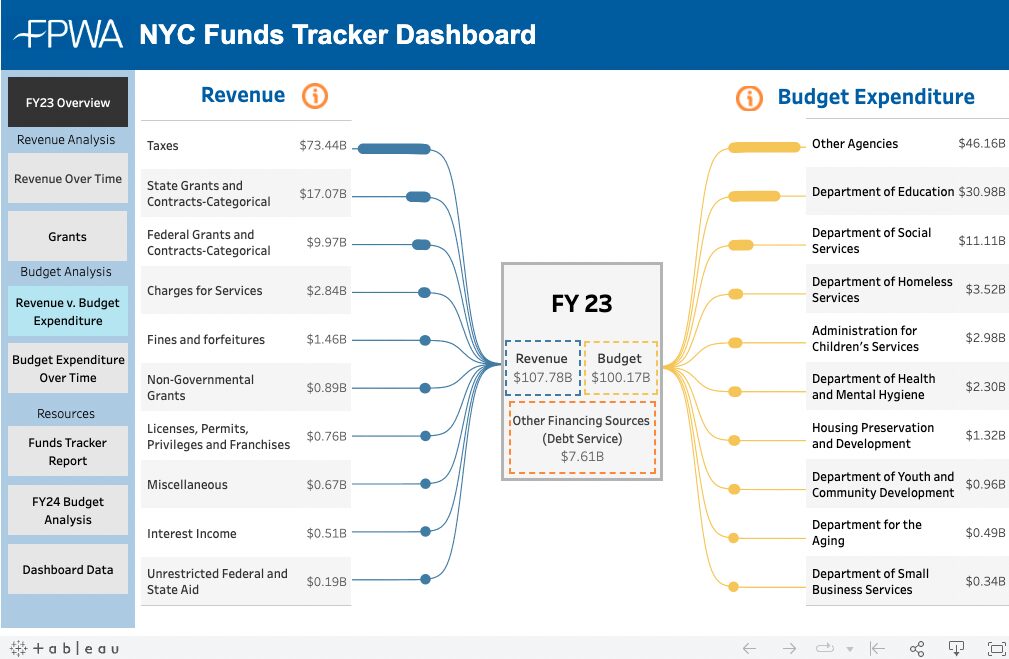
On February 17, 2026, Mayor Mamdani released the Fiscal Year 2027 (FY27) Preliminary Budget, outlining $127 billion in revenue and expenditures.
The Mamdani administration has made budgeting transparency a cornerstone of their approach, bringing to light chronic underbudgeting of public assistance and education by the previous administration. Combined with a $1.9 billion decline in federal grants and state cost shifts, this has left New York City in a precarious position, with an estimated $5.4 billion budget gap over the next fiscal year, and growing gaps in the out-years.
Just as the City is struggling to find resources to cover all necessary costs, many New Yorkers face similar challenges. Citywide, 62 percent of residents do not have the resources they need to meet recurring household costs and save for the future. For families with children, this rises to 73 percent, with the median gap between costs and available resources exceeding $35,000.
With the federal government continuing to withdraw support and state grants failing to cover the gaps, the City will need to cover 78.2 percent of total costs, nearly 3 percent more than FY25. Altogether, the City projects a need to raise an additional $9.3 billion in revenue in FY27.
To meet this need, Mayor Mamdani must raise revenue. He has proposed two options: raising taxes on New Yorkers earning more than $1 million annually and the most profitable corporations or implementing a 9.5 percent increase in property taxes citywide paired with unspecified savings and use of the City’s Rainy Day Reserves. Because the first option requires state legislation and has not passed, the Preliminary Budget relies on the second path, as this is within the City’s control. Importantly, this approach risks worsening affordability, particularly for lower income neighborhoods and renters in large buildings, and is likely to increase the economic insecurity of many New Yorkers.
In the following sections, FPWA provides an overview of how the Preliminary Budget meets fiscal constraints and fosters opportunities to ensure economic security. The report first outlines revenue trends, including the reductions in federal and state funding that have challenged the City’s budget, and then provides an overview of City spending and the impact on individuals and families’ access to resources and the human services sector. Finally, the report provides guidance on steps the City and State should take to equitably increase revenue to fully fund the City.
Revenue Trends
Reduction in Federal Grants Impacts Key Services
The Preliminary Budget forecasts a nearly 20 percent decline in federal grants in FY27, totaling more than $1.9 billion. This loss affects all areas of City funding but falls most heavily on human services and housing.
The largest losses occur in Health and Human Services ($600 million, 14.5% decrease) and Housing and Urban Development ($463 million, 31% decrease). While a wide variety of programs are impacted, the largest losses are on programs supported by the Child Care and Development Block Grant and Section 8 vouchers, impacting the City’s ability to ensure child care and housing supports.
These projected grant losses build on long-term declines. As documented in FPWA’s NYC Funds Tracker FY25 Annual Report, federal funding declined 20 percent between FY11 and FY25, when adjusted for inflation.
Additionally, the City may struggle to collect even the reduced grant amounts. In FY25, collections of Temporary Assistance for Needy Families (TANF) funding fell by 31 percent, despite increased demand. If these funds are not recuperated in the current fiscal year, the City could be forced to pay for incurred costs, on top of anticipated expenses.
Other Federal Policies Challenge NYC’s Fiscal Position
Reductions in federal grants represent only part of the broader loss of federal support that is impacting New Yorkers. According to New York City Comptroller estimates, over $100 billion in federal funding went to New York in FY25, meaning City grants only make up one-tenth of federal funding supports.
The Trump administration’s cuts to Medicaid, the Essential Plan, and SNAP drastically reduce the services available to New Yorkers but are not directly represented in the city’s revenue losses. Estimates find that these changes could cause over 1.2 million New Yorkers to become uninsured and 180,000 city residents to lose food support. As the federal government pushes more New Yorkers into economic precarity, additional strain will be put on the City to stabilize individuals and families.
The State Shifts Costs to the City, Even as It Increases Grants
Preliminary projections of state funding reveal a cautious, rather than enthusiastic, fiscal partner.
While the state has committed nearly $1.5 billion for FY26 and FY27, ensuring continuity of youth programming and other underfunded costs, it has not yet agreed on how to address a number of cost shifts towards the city.
For example, FY25 changes to the Foundation Aid formula resulted in $314 million less funding for New York City last year. According to Independent Budget Office estimates, if the legislature updated the regional cost index this year, the city could receive $539.7 million more than is currently allocated in the Governor’s budget.
FPWA has also highlighted the state’s reduction of funding for Preventive Service in FY25 (a decrease of nearly $400 million or 54% from FY24) which remains unaddressed in the Governor’s budget.
Furthermore, the Mamdani administration has called specific attention to a number of other cost-shifts, including $1.5 billion in health and human services expenditures shifted by then Governor Cuomo to reduce state costs during the COVID-19 pandemic. These state funding shifts impact high-cost areas for the City including Cash Assistance (TANF), children’s health care (eFMAP), and shelter (Adult Shelter Reimbursement).
What the Budget Means for Human Services & Economic Security
Deep underbudgeting of public assistance and education, along with rising costs and a failure to ensure the wealthiest New Yorkers contribute equitably, has left the city in a precarious position. With a lack of resources, the Preliminary Budget threatens to cut needed public funding across agencies.
The City is responsible for a variety of necessary goods and services that support individuals and families. According to New York City’s True Cost of Living (TCOL) measure, these resources increase the number of New Yorkers who are able to meet the city’s true cost of living by 5 percentage points and reduce the resource gap of many other New Yorkers struggling to reach the threshold. Failing to properly fund these programs will worsen economic insecurity.
Below, FPWA details where the City’s Preliminary Budget does not sufficiently invest in the goods and services needed to ensure that all New Yorkers can thrive.
Impact on Human Services
Previously, the City’s budget has failed to reflect the size and scale of needed public support, often underbudgeting public assistance and relying on mid-year adjustments to meet expenditures.
The FY27 Preliminary Budget marks a departure from this framework, accounting for $14.2 billion in underbudgeted and unfunded expenses for FY26 and FY27. These expenses include a range of key human service expenses, including housing, shelter, and cash assistance. The inclusion of this funding in the City’s planning reduces precarity for supported programs.
However, challenges remain. The Preliminary Budget makes larges cuts to the Mayor’s Office of Contract Services ($9.8 million, 20% decrease) and to community development spending ($120 million, 74.3% decrease), threatening nonprofit service providers and the communities who rely on them.
The budget further reduces key programs for families and individuals supported by the human service sector that may worsen current administrative challenges, covered in more detail below.
Impact on Housing
Due to the proposed property tax increase, the Preliminary Budget would increase housing costs, likely exacerbating existing tax inequities that overburden lower- and middle- income households. At the same time, it increases funding dedicated to housing when looking across the operating and capital budget.
The funding increases provided in the Preliminary Budget are focused on chronically underbudgeted shelter intake ($373.8 million, 22% increase) and voucher costs ($1.13 billion, 109% increase). Even with the additional funding, however, shelter and voucher programs may still be underbudgeted given past expense levels, expected demands, and ongoing administrative challenges that make it difficult for individuals and families to access quality services. Of note, the Preliminary Budget has not provided funding for the Council-mandated expansion of CityFHEPs eligibility to families at risk of facing eviction.
And while the Preliminary Budget does make needed capital investments in the City’s housing stock ($2.21 billion, 2% increase), it decreases funding for NYCHA operations ($161 million, 30% decrease) and funding for rental subsidies ($211.3 million, 23.2% decrease).
Under projected funding levels, the city’s housing system will struggle to improve service delivery for individuals and families and may stay stuck in crisis management, rather than building long-term solutions to the housing crisis.
Impact on Health
Although anticipated state and federal aid from the State budget and one-time grants are not included in the Preliminary Budget, decreases in Health + Hospitals budget ($386.7 million, 18%) threaten the ability of New Yorkers to access health care. While the state is considering policies to help hospitals manage funding losses, projected health insurance losses due to federal policy changes will strain the city’s health care system. Without state intervention, 470,000 New Yorkers will lose their health insurance as of July 2026.
Furthermore, the Preliminary Budget fails to adequately fund the Department of Health and Mental Hygiene and includes a 49.1 percent ($41 million) decrease for out-of-home services and a 9.1 percent ($11.2 million) decrease for in-home services.
Overall, this underbudgeting, decrease in funding, and anticipated loss of insurance will make New Yorkers sicker and more vulnerable, with a particular impact anticipated for older adults.
Impact on Child Care & K-12 Education
The Preliminary Budget makes important strides to set the foundation for universal child care and increases overall education funding. Still, it struggles to fill federal losses. The impact of federal shifts on the budget is, as of yet, unknown.
With state support, the Preliminary Budget increases FY27 investments for the Department of Education by 8.2 percent over current spending. Specifically, there is a $571.6 million (34%) increase for Universal Pre-K, $103 million (21.5%) increase for early childhood programs, $90.1 million (560%) increase for Summer Rising, a program that provides both educational opportunity and child care for city students, and $543 million for state-mandated classroom size reductions which, while anticipated, had not been budgeted for previously.
At the same time, the Preliminary Budget projects funding losses to vital programs, including a $438.5 million (36.6%) decrease in Head Start and Daycare funding due to federal grant cuts to the Child Care Development Block Grant and Headstart Program. Moreover, child care advocates have called attention to an anticipated loss of over $76.3 million in non-baselined funding intended to support critical education programs for lower-resourced communities.
As New York seeks to strengthen child care and early education access, it is essential that the City ensure continuity of funding for providers and prevent disruptions to recipients.
Impact on Transportation
One of Mayor Mamdani’s signature policy proposals, Fast and Free Buses, is not in the Preliminary Budget. Instead, we see a $25 million (20.7%) reduction in funding for Fair Fares, a program that provides low-income New Yorkers with reduced transit costs.
Impact on Food Security
Federal funding for SNAP has been drastically reduced under the Trump administration, with an anticipated $186 billion or 20% loss over 10 years. Other policy changes shift the cost of the program from the federal government to states and implement work requirements that push people off the program. At the same time, food costs are rising. Against this backdrop, we can anticipate additional food insecurity across the city.
While the City seeks to address the rising cost of food, providing $70 million for the Mayor’s city-run grocery store initiative, the Preliminary Budget leaves emergency food assistance programs underfunded with a $5 million (6.4%) decrease in funding for Emergency Food Assistance Programs. For the City’s community kitchen and food pantry program, Community Food Connection, the budget provides $53.6 million which is below the $100 million that is required to meet rising demands for food assistance.
Impact on Labor and Wages
As projected, the Preliminary Budget provides a 1.25 percent increase in city employee wages. While this is the typical bargaining position for the City, it hides the cost of necessary increases.
This summer, the City will enter into a new round of collective bargaining to determine the wage schedule of public employees over the next five years. These negotiations could be pivotal, not only for city workers, but for the wider labor market where many are struggling to meet the cost of living.
Recent job growth has concentrated in low-income sectors that have a large portion of city-contracted workers, such as home health aide employment with an average salary of $25,119. Under current labor agreements, the city relies on underpaid human services contractors, who earn 25 to 30 percent less than their similarly situated counterparts in city agencies.
The City faces a dual challenge of not only providing cost-of-living increases for city workers but also creating salary parity across its workforce. The upcoming labor negotiations have the potential to influence the prevailing wage offered to workers beyond those employed directly by the City.
With inflation anticipated to climb as high as 4.2 percent amid geopolitical instability tied to federal actions, the City would require at least $2 billion more per year, once negotiations are finalized, than currently budgeted to keep pace with rising costs. Factoring in human service worker salary parity, which the Center for New Yorker City Affairs estimates would cost an additional $965 million to $1.35 billion annually (once phased in), and the Preliminary Budget may be underbudgeting future labor costs by $3 billion.
Impact on Economic Mobility
In addition to underbudgeting labor costs, the Preliminary Budget fails to sufficiently invest in programs that support economic mobility.
Specifically, it cuts CUNY funding by $68 million (4.2% decrease), with these cuts falling almost entirely on community colleges. CUNY colleges, including its community colleges, consistently rank as some of the best schools for social mobility and return on investments.
Additionally, Small Business Services (SBS) faces worryingly large cuts ($154.2 million, 45.4% decrease). While this agency often receives additional Council funding later in the year, these cuts are notably deep. SBS plays an important role supporting small businesses and ensuring that the city uses its procurement power to support Minority and Women-owned Business Enterprises. The City must ensure that its budget cuts do not affect the ability of New Yorkers to positively shape and grow the local economy.
Without proper labor and small business support, New Yorkers will struggle to obtain the resources they need to meet the cost of living.
Big Picture Takeaway
The Preliminary Budget shows the extent of the City’s fiscal imbalance – with costs increasing, federal support falling, and taxes failing to provide sufficient revenue or ensure equitable investments. After accounting for underbudget costs, federal losses, and slowing economic growth, the city faces a $5.4 billion budget gap.
This fiscal imbalance is driven by the City’s failure to tax wealth and provide services that build economic security for all New Yorkers, ensuring a robust tax base. Under proposed funding levels, economic security would be further out of reach for many New Yorkers. Key housing, health care and child care supports face major cuts. At the same time, labor is put at a disadvantage to obtain necessary wage increases and pathways to economic mobility are narrowed.
Going Forward
Our fiscal future relies on the city’s ability to deal with this legacy of growing economic insecurity and make different choices. While the City faces fiscal challenges, it is also home to vast amounts of wealth.
New York City residents hold over $3 trillion in personal wealth, a number that has ballooned in recent years, with overall stock market value increasing 109 percent since 2020.
To meet its fiscal challenge, the City must draw on these vast resources to ensure they are in service of the public, building economic security for all communities. The FY27 preliminary budget takes the first steps towards that path, and can be improved by:
- Working with the State to raise tax revenues on the wealthiest individuals and corporations.
- Prioritizing and budgeting for economic security for city workers and those with contracts with the city, particularly human service workers who are often furthest away from reaching the true cost of living.
- Seeking additional state assistance to fill underbudgeting of housing, health care, and education.
- Improving processes to budget for equity, drawing on the City’s True Cost of Living (TCOL) framework and forthcoming Racial Justice Equity plans to reflect and prioritize revenue and spending measures that build economic security for all.