NYC Funds Tracker FY25 Annual Report
Published February 5, 2026
Summary
At the time of publication, New York City is confronting an estimated budget gap of $12 billion over the current and next fiscal years (FY26 and FY27). The Mamdani Administration must confront this gap and propose a balanced budget, one that deals with years of increasing costs and reduced investments from the Federal government.
Federal attacks have made New York City vulnerable with the Trump Administration slashing vital funds for healthcare and nutrition, dismantling government infrastructure, and targeting its population with violence. At the same time, costs for both New Yorkers and the public sector have risen, with healthcare, housing, and education expenses increasing for more than a decade. Since the pandemic, the pace of cost growth has quickened, causing demand for public assistance to soar and strain human service capacity while the Federal government actively disinvests in our cities.
The current Federal disinvestment is only a portion of the budgetary challenge that New York faces, as pressures have been mounting for years. Over the past decade, income inequality has grown in the City, making the City’s revenue from taxes more precarious just as a larger portion of the City’s budget necessarily draws from this revenue.
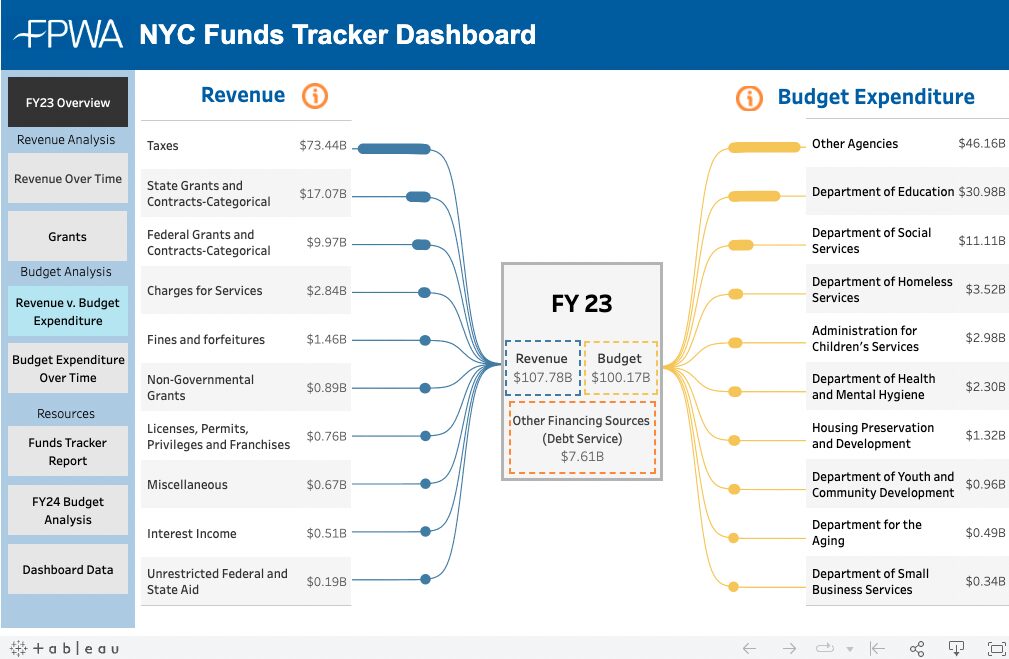
In this report, FPWA examines how the City’s budget—and its ability to serve New Yorkers—has evolved over time. Drawing on the latest annual update to FPWA’s NYC Funds Tracker, a dashboard that monitors trends in New York City’s operating revenues and expenditures, this report places recent funding shifts from Fiscal Year 2025 (FY25) in the context of more than a decade of budgetary data dating back to Fiscal Year 2011 (FY11).
Situating our most recent City budget in this historical context gives us perspective into the fiscal policy decisions that impact long-term public capacity.
What is the NYC Funds Tracker:
The NYC Funds Tracker is a data visualization dashboard that provides an overview of the City’s budgetary trends, both in revenue and expenditure, over the past decade and beyond.
Through this analysis, FPWA quantifies how tax burdens on the lowest resourced New Yorkers and inadequate Federal grant dollars have contributed to chronic underinvestment in public goods—fueling the affordability crisis the City faces today.
This analysis highlights concrete fiscal interventions grounded in equity.
By prioritizing economic security in budgetary policy, through a reconfiguration of the tax base, an expansion of alternative sources of City revenue, and the expansion of human-centered investments, New York City’s budget can—and must—lay the foundation for a more just future.
FY25 Budget Overview
To plan for a stronger fiscal future, it is necessary to understand the budgetary mechanics shaping the present.
Each fiscal year, New York City works to ensure that public spending does not exceed annual revenues, as mandated by the City Charter.
About the Fiscal Year (FY)
A fiscal year defines the span of a 1-year budgetary period and is often asynchronous with the calendar year.
New York City’s fiscal year begins on July 1st of a calendar year and ends on June 30th of the following calendar year.
For reference, NYC’s Fiscal Year 2025 (FY25) spanned from July 1, 2024 to June 30, 2025.
For more information on the City’s budget timelines and process, visit FPWA’s Budget Watch page.
In FY25, the City managed to balance its budget with $117.7 billion in revenue and expenditure. This represents a 3.1% increase over the previous year’s budget, or 1.4% when adjusted for inflation. While this budgetary growth is positive, it is modest in context of the growth in personal wealth held by New Yorkers, which soared as Wall Street recorded historic gains, with the S&P 500 up 17.9% in 2025, and up 100.6% since October of 2022.
At the same time, most New Yorkers are not benefiting from record Wall Street returns. In fact, 62% of New Yorkers are economically insecure, not having enough resources to cover their daily costs and save for the future. The City faces increasing costs to help residents make ends meet and build toward economic security.
Moreover, while New York City’s revenue grew in FY25, collection is still below the FY22 pandemic-high, which reached $120.8 billion in inflation-adjusted dollars.

Despite modest growth in FY25, the City’s overall capacity to meet New Yorkers’ needs has contracted.
This decrease in budgetary capacity is a risk for future fiscal years, with the City forecasting growing budget gaps.
Revenue Trends
The NYC Funds Tracker allows users to explore revenue trends over time. Revenue is central to public capacity. It determines how much the City can spend on services and, through its collection, structures financial relationships across the broader economy.
Today, the City’s revenue is made up of three primary sources: City sources, Federal grants, and State grants.
Over time, the City has supported a greater share of overall revenue with its own sources, as Federal grants shrink and State grants have not filled gaps.
In FY25, 75.3% of overall revenue came from City revenue sources, primarily raised from taxes, while State grants and Federal grants made up 17% and 7.7% of overall revenue, respectively.

The overall revenue base, when adjusted for inflation, has grown by over 25% since FY11. Growth in City tax revenue has made up the vast majority of revenue growth (80%). Over that same time period, Federal grants, when inflation-adjusted, are down almost 20%.
These changes in revenue composition have directly impacted public investment in New Yorkers. Human service funding, which has historically received a large portion of its funding from through Federal and State grants, has become more vulnerable. At the same time, the City is increasingly reliant on taxes for a larger portion of its budget, many of which disproportionately burden low- and middle-income New Yorkers.
An examination of the current revenue structure across City, Federal, and State sources shows how it has produced a budgetary calculus that works against New Yorkers’ economic security.
Overview of City-Generated Revenue
In FY25, the City generated $89 billion in revenue (75.3%) from its own sources. This is up from past years, with City funding making up 71.0% of funding at the height of the pandemic in FY22.
Taxes are the primary source of revenue and revenue growth for the City. To put the City’s dependence on taxes into perspective, taxes accounted for 91% of the City’s own revenue capacity in FY25 ($80 billion of the total $89 billion).
As the City’s primary fiscal tool, taxes play a pivotal role in defining and shaping claims over the City’s resources. More specifically, taxes codify and direct financial flows, determining where resources are directed and where they are allowed to accumulate.
An examination of the City’s tax base reveals structural inequities which have encouraged the accumulation of real estate, corporate profits, and personal income in the hands of a privileged portion of City residents. While these residents enjoy increased wealth, this consolidation is now hurting the City’s capacity to raise revenue.
City Taxes
Tax Revenues Up Primarily Due to Shifts on Wall Street
The City’s tax base comes primarily from the following four sources, listed in descending order of revenue generation: property tax, income tax, business tax, and sales tax.
In FY25, tax revenues grew 5.5%, driven primarily from an increase in personal income tax collection.
Personal income taxes are the second largest source of tax revenue after property taxes, making up 13.7% of the City’s overall budget. Between FY24 and FY25, personal income taxes grew 11.6%, accounting for an additional $1.7 billion in revenue after adjusting for inflation.
Personal income tax collection rose notably in FY25 due to volatility on Wall Street. Not only did the stock market go on a record run, increasing personal wealth, there was also a massive sell-off of stocks in April of 2025 due to the crash in stock value following Trump’s “Liberation Day Tariffs.” This temporary decrease in stock value and subsequent sell-off benefitted City coffers as the City is only able to collect taxes on capital gains once a stock is sold and registered as part of a person’s income. The stock market ultimately recovered, leaving the City’s revenue base intact.
Still, personal income taxes, while up over the long run, are substantially lower than their peak in FY22. When adjusting for inflation, personal income taxes are down 15%.
Personal Income Tax Collection Down Due to Shifting Revenues

The decline in personal income tax collection over the last several years is due to the creation of the Pass-Through Entity Tax that provides a different process for reporting personal income.
The Pass-Through Entity Tax (PTET) was created in New York as a reaction to the 2017 Federal Tax Cuts and Jobs Act which eliminated the ability for residents to deduct State and Local Taxes (SALT) from Federal-tax liability, a deduction that primarily benefits high income earners in high tax states. Essentially, PTET is designed to mimic the SALT deduction, creating a process by which shareholders in certain partnerships and corporations can deduct state and local taxes from their Federal personal income tax liability. Due to the complexities and benefits of the PTET, the vast majority of taxpayers that take advantage of PTET are residents of New York with high incomes who shift their personal income to pass-through entities.
While PTET is not supposed to affect how much an individual owes in local tax, there has been large volatility in the City’s revenue collection from the program. From FY24 to FY25, PTET collections increased 39%. But in FY24, PTET collections decreased 32.8%. Part of this volatility is due to misallocations in tax income between the City and State, because of the complexity of the tax structure.
Pass-Through Entity Tax Collections Fluctuate Year-to-Year

As more carve outs are made for New York’s wealthiest, the tax system becomes less transparent. This not only makes the overall tax base more volatile, it also makes it more difficult to understand how personal income is shifting and hinders the City’s ability to tax wealth appropriately.
Income Tax Collections Down Even When Accounting for Revenue Shifts

When accounting for the splitting of personal income between multiple tax streams, summing personal income and pass-through entity tax collection together, tax incomes are still below FY22 collection levels.
This weakening tax collection since the pandemic reflects an inability to collect taxes on much of the wealth that is traded in New York, tied up in capital assets, as well as a worsening economy for workers, as unemployment increases, inflation ticks upwards, and economic growth slows.
Not all changes to the tax code have been regressive, however; the “Axe the Tax” measure, which goes into effect in FY26, eliminates City personal income tax burdens for New Yorkers earning up to 150% of the federal poverty level. It is estimated that this change will only cost the City $50 million in tax revenue (0.3% of its overall collection) but put an additional $408 million in the pockets of low-income New Yorkers. Some portion of this additional cash will be spent in the local economy, generating positive economic benefits for the City largely.
Future tax changes should continue to center equitability, reducing burdens for those with lower incomes, and reducing complexity to increase transparency and accountability.
Property Tax Collection Recovering, But Exacerbating Affordability Crisis
The overall increase in FY25 revenue can also be attributed to an increase in real estate taxes, which make up both the largest source of taxes as well as the largest source of overall revenue. When adjusting for inflation, real estate taxes increased $900 million in FY25, up 2.7% from FY24. In spite of “improving” real estate tax collection, higher property taxes also contribute to the unaffordability crisis in housing and is again an example of the inequality within New York City.
While property tax collection was up in FY25, they remain below pandemic-era tax collections, which reached their peak in FY21 as home sales, and prices, soared.
Compared to FY21, real estate tax income has fallen due to rising mortgage rates suppressing prices and keeping sales stagnant. While real estate tax collections have recovered to pre-pandemic levels after a brief dip, the high cost of housing continues to be a drag on the City’s economy, making life unaffordable for many.
In some ways, the current property tax system exacerbates this housing crisis by placing a disproportionate burden on lower-income New Yorkers. According to CSS’s March 2025 report, properties worth between $500,000 and $600,000 per unit have an average effective tax rate that is 1.3 times higher than those worth more than $1 million. Similarly, single family homes—including mansions and brownstones in neighborhoods like Forest Hills, Queens and Prospect Park, Brooklyn— have an estimated tax rate (ETR) that is 2.4 times less than low-density rentals and homeowners in Staten Island, Southeast Queens, Eastern Brooklyn, and the Northeast Bronx whose homes are valued at far less. These homeowners sometimes pay three times the effective tax rate of homeowners in Manhattan and brownstone Brooklyn. The current property tax system significantly favors New Yorkers living in high-wealth neighborhoods over those in lower-wealth neighborhoods.
In taxing lower-wealth neighborhoods at higher rates, the property tax system exacerbates housing unaffordability by increasing costs at the low-end of the market. At the same time, it reduces the costs of housing for those at the high end of the housing market. To ensure a vibrant city for all New Yorkers, the City must build a property tax system that works towards housing accessibility, not just market growth.
Sales Tax Growth Slows as Consumer Base Shrinks
Another important source of tax revenue for the City is the general sales tax, which makes up 6.4% of the City’s tax base ($7.5 billion in FY25). This large source of tax means that consumer spending is a direct and critical part of the City’s fiscal landscape. This tax base suffered during the pandemic but recovered quickly due to Federal stimulus investments. In FY25, general sales tax collection, when adjusting for inflation, increased 1.4%.

Yet while tax collection has recovered, consumer activity is being negatively impacted by larger economic forces. The Trump tariffs caused economic chaos, although the effect on overall economic activity is not clear. More significantly, longer term trends in shopping habits continue to shift, as consumers move from in-person retail to online shopping. This increase in online sales not only means New York is losing small business, it also means that the tax base has become more precarious. As fewer consumers come into New York to shop and instead make their purchases online, the City loses out on the revenue from sales tax. Meanwhile, as retail businesses face challenges, consumer spending growth is increasingly concentrated at the top, as consumer sentiment continues to worsen as Trump policies and price level increases deepen the cost-of-living crisis. In the face of changing sales dynamics, many small businesses are struggling to stay open. The combination of these sales trends, as consumption becomes increasingly driven by a smaller set of high-income consumers and large online retailers, represents a real threat to the City’s revenue base.
In light of the risks to sales tax growth, the City should prioritize policies that reduce pressures on lower- and middle-income New Yorkers. Additional policies for exploration could include reducing taxes on brick-and-mortar small businesses or differentiating taxes on luxury goods.
Tax Collections on Corporations Down
While consumers are struggling to make ends meet, New York tax collection on corporations is also down.
Business corporation tax collection, which makes up 6.3% of the City’s overall revenues, was down 2.4% in FY25.
This is a concerning indication of the City’s overall tax capacity. While business corporation taxes have increased over time, much of that revenue growth is due to revenue shifting rather than true growth.
Following a 2015 State tax change, New York City incorporated a majority of the financial corporation tax into the general corporation tax. Although this new tax structure is now referred to as business corporation taxes, the Comptroller data still lists the data under the general corporation tax, with revenue shifting from the financial corporation tax base to the general corporation tax base.

When taking general corporation tax and financial corporation tax revenues together, tax revenues increased 24%, which is relatively low compared to realized business growth. For context, around 75% of all New York corporate tax revenue is collected from the 500 most profitable corporations, whose revenues have more than doubled over the same time period.
A Majority of Business Are Not Subject to General Corporation Tax, Instead Being Taxed At Lower Unincorporated Business Tax Rates

And while taxes on corporations have not kept pace with revenue growth, revenue from unincorporated businesses is growing.
The unincorporated business tax (UBT) levies a flat 4% tax on sole proprietorships, partnerships, estates, and trusts. In FY25, UBT grew substantially, increasing 15.9% to bring in over $4 billion in revenue for the City. The FY25 increase continues the trend of long-term growth in UBT, which has increased 46% since FY11.
This increase is particularly notable because while UBT applies to a wide range of businesses from mom-and-pop shops to individual contractors and trusts, a majority of the tax liability has historically come from industries including finance and insurance, professional services and legal industries. Yet while the majority of UBT collections comes from white-collar industry, the UBT rate is far lower than the corporate tax rate which ranges from 4.3% on manufacturing firms to 9% on financial corporations.
The City should increase transparency on current UBT liabilities to further examine its equitability.
Trump Effects on Tax Collection
As mentioned in previous sections, FY25 tax collection has been impacted by Trump’s policies, with tariffs impacting sales tax and corporation tax. At the same time, tax impacts in FY25 from the Trump Administration’s policy of disinvestment has been relatively minimal, as the disinvestments of H.R. 1 are yet to take effect. Anticipated increases in healthcare prices and decreases to social safety net funding create austerity conditions that will be a drag on personal income, business, sales, and property tax collection.
Given the volatility of tax revenue, the City must evaluate alternative revenue sources.
Non-Tax City Revenue Sources Have Decreased
While most of the City’s revenue comes from taxes, a non-trivial portion is collected from other sources, including charges for services, fines and forfeitures, non-governmental grants, licenses, permits, privileges and franchises, investor income, debt service and other miscellaneous sources.
Selected Non-Tax Revenues, FY11-FY25

City Fails to Collect Billions in Services and Fine Revenues
In FY25, the City’s revenues from charges, including charges for services, fines and forfeitures, and licensing and permitting increased. This revenue has recovered following pandemic decreases. In particular, charges for services, which make up 3% of the City’s overall revenue (including Federal and State grants), increased 8.4% in FY25. Charges for services include tuition from City University of New York (CUNY) colleges and charges for services rendered by the City to public and governmental agencies. These include over 100 service charges such as fees (parking and towing), inspections (fire and building), administration (copies of certificates and processing applications) as well as water and sewer charges.
Additionally, fines and forfeitures, which contribute 1.2% to the City’s overall revenues, increased 1.6% in FY25. Fines can be levied on vehicle, building code, consumer affairs, and public health violations. Forfeitures, on the other hand, are surrendered and converted into cash, bail, and contractors’ performance bonds. The city has reviewed and reduced the forfeiture fees following evidence that using financial penalties in the criminal justice system worsens outcomes for justice-involved individuals.
Moreover, licensing, permitting, privileges, and franchise revenue, which make up 0.6% of the overall budget, also went up, but only slightly – increasing 0.19% in FY25.
While the City’s revenues from these sources have gone up, billions of dollars go uncollected. According to the New York City Comptroller’s 2025 Annual Comprehensive Financial Report (ACFR), the Environmental Control Board (ECB) failed to collect over $1.3 billion in fines. The ECB is responsible for enforcing many quality of life issues, processing violations for a number of agencies including, the Department of Buildings (DOB), Housing Preservation and Development (HPD), the Fire Department (FDNY), the Department of Sanitation (DSNY), the Department of Environmental Protection (DEP) and the Department of Parks and Recreation (Parks). These violations can include work without permit, illegal conversions of buildings, failure to maintain property, failure to certify buildings, and other unsafe conditions and violations. While some of these fines are considered uncollectible, at least $435 million are fines on corporations that are owed and collectible, as reported in the ACFR. To both raise revenue and curb unsafe practices, the City must collect fines from bad actors while continuing to evaluate the root cause of collection issues. The City should continue to evaluate how it can more effectively collect fines, while upholding equity principles, ensuring that shared spaces are respected and appropriately resourced.
Private Financing Sources Decreased Notably
Another small, but still meaningful revenue source for the City is private financing. In FY25, the City collected nearly $800 million in private grant money, also known as non-governmental grants. Non-governmental grants are monies either directly donated or programs sponsored by private organizations, typically through a charitable organization or corporation. In FY11, private organizations donated a billion dollars more than they did in FY25. While revenue from non-governmental grants has been subject to volatility, the overall trend has been a meaningful decline in contributions, with private grants down almost 22% since FY24, 47.1% since FY19, and 56% since FY11.

Another source of private financing revenue, investment income, decreased in FY25. Investment income netted $641 million, or 0.5% of the City’s overall revenue, in FY25. This is a 10.3% decrease from the previous year, in part due to the volatility in stock market performance. Still, while there was a minor decrease in FY25, the City’s investment income is up 2,047% since FY11.
Transfers Temporarily Increase Operational Revenues, But Risks Remain
The City drew on its debt funds, built up during the pandemic, for additional operating funds in FY25.
Through transfers from the general debt service fund and non-major debt service fund, the City added $246 million in operational revenue capacity. These transfer amounts are higher than the previous year, but not an uncommon practice from previous fiscal years.
While the City was able to dip into debt service funds, it may face rising debt costs in future years that will prevent it from using these funds. In FY25, the State increased the City’s debt-limit for capital projects. While this will provide the City more capital budget, the City will have to spend more of its operational expenditures to finance the additional debt, decreasing the operational expenditures available for services.
Federal Grants at their Lowest Point in the History of Funds Tracker
Although City revenue sources are increasing overall, the City is not able to make up for the dramatic loss of revenue in Federal support.
In FY25, the Federal government provided $9.1 billion in grant support, making up 7.8% of the City’s budget, the lowest level in the history of the NYC Funds Tracker. This decrease is primarily attributed to expiring pandemic funds and does not account for Federal policy changes under Trump which will impact grant levels in future years. Still, Federal grants were below pre-pandemic inflation-adjusted levels, dating back as far as FY11.
Federal Revenue, FY11-FY25

Even more striking is that while recent Federal grants have decreased substantially, falling over 21% between FY24 and FY25, the historically low grant levels do not account for cuts made in Trump’s 2025 Federal H.R. 1 Budget, which only begin to take effect in NYC’s FY26 budget and beyond.
This means that the latest FY25 decrease in Federal grants does not reflect cuts to Medicaid, childcare, education or housing anticipated following implementation of H.R. 1 and future Trump Administration budgets. In fact, Federal funding for the Childcare and Development Block Grant, and Section 8 vouchers increased slightly in FY25 and Medicaid remained stagnant, trends that are not expected to continue.
FY25 Federal Grant Levels Do Not Include HR.1 Impacts

Instead, the recent decrease in Federal funding largely comes from a decrease in pandemic aid and Temporary Assistance for Needy Families (TANF).
Time-Limited Pandemic Education Support Expires
Most notably, the City suffered large losses in Federal support with the end of pandemic education funding. With the end of the Federal Education Stabilization grant funding, the City lost $4 billion in funds between FY24 and FY25. The end of this funding posed a unique funding challenge because while it was time-limited, the grant was used to support recurring expenditures. The grant revenues supported a wide-range of education related expenditures from 3-K, to preschool special education, Summer Rising, school staffing, community schools, restorative justice programs, homeless shelter coordinators, dyslexia and literacy initiatives, and much more.

The loss of these grants jeopardized the foundation of New York City’s education system, and had to be filled with a combination of State and City revenues.
TANF Grants to City Fall 31%, Worsening Revenue Volatility that Jeopardizes Programs
In addition to education aid losses, the City saw a dramatic reduction in Federal Temporary Assistance for Needy Families (TANF) grants, which fell 31% in FY25.
TANF is the largest Federal block grant program, designed in 1996 to fund cash assistance and other supports for low-income families with children. This program has become less generous over time. Because the Federal government failed to adjust the program with inflation, the real value of overall TANF benefits to States has decreased by 40% since its inception. Yet despite fiscal attacks on the program, it continues to represent a vital portion of Federal funding for public benefits in New York City.
The FY25 decrease comes with no meaningful legislative change to TANF’s Federal formula and drastic increases in demand for assistance, which is up over 35% from just five years ago.
At this time, the factors that drove the City’s TANF receipts down in FY25 are not clear from publicly available data. While the specific factors are not known, the City has faced several administrative difficulties that may affect its ability to bill for incurred expenses. The City faces both internal challenges, with higher attrition of leadership and staffing, and from the Federal government, as the City tries to adapt to changing rules that add additional administrative burden.
The full impact of this dramatic decrease in funding is hard to estimate. Over half a million New Yorkers receive cash assistance each year, and thousands of others benefit from programs supported by TANF funding, including family shelter. While Federal decreases in support put these services at risk, it is unclear how they translate into service delivery. Accounting practices allow the City flexibility to bill already incurred expenses from one fiscal period to another, meaning that extent of funding losses, nor its impact on services, is likely not yet fully realized. According to the Comptroller, if the Federal government does not book more revenue in the following fiscal year, it will need to find a way to pay for hundreds of millions of dollars in already incurred expenses through other City revenue sources.
Beyond cash assistance, child welfare services, employment programs, administrative costs, and other qualifying expenditures will be impacted by the changes to TANF funding. As New York City faces greater volatility in TANF receipts, it must seek alternative sources of financing to continue supporting vital social services, like City taxes, which may be less able to adjust to need-level.
In this way, the future of TANF funding, which is still one of the largest sources of Federal funding to the City, will continue to be volatile and insufficient – as it has been throughout the history of the NYC Funds Tracker.
As the City anticipates the impact of deepening Federal cuts, its fiscal and political imagination must extend beyond the restoration of business as usual, laying out a new vision of economic and social rights for all, rather than simply working to maintain a broken system that provided too little to too few New Yorkers.
State Grants for Education and Human Services are Insufficient
As Federal cuts impact the City, State grants have failed to make up lost funds and ensure necessary investments in economic security.
While nominal grant funding increased, from $19.2 billion to $20 billion, the proportion of the budget that State grants support remained the same between FY24 and FY25 at 17%. At the same time, there was a decrease in State grants to several City programs, some of which compound Federal losses.
State grant losses fall most heavily on programs that support the social safety net.
State funding for Safety Net Assistance (SNA), a State program which supplements TANF funding, has slightly decreased, while TANF dropped precipitously.
State and Federal Safety Net Programs Both Decrease (Inflation-Adjusted)

Making matters worse, the State has drastically reduced its grant funding for preventative services programs, which serves the primary purpose of preventing children from entering the foster system through supporting a broad set of safety net assistance. The grants fund a nexus of vital programs provided by community-based organizations including family relationship and teen services, education and job training, food, clothing and household item distribution, public assistance and immigration services.
Despite sustained demand for essential preventative services amidst the growing affordability crisis, funding for State preventive service declined by –54%.

Similar to TANF decreases, the reason for this massive drop in FY25 funding is not clear from publicly available information. While there were no direct cuts imposed on the Federal grant program that supports Preventative Services (the Social Services Block Grant), it is possible these programs, which like TANF-supported services are also reimbursed once expenses are already incurred, have not been processed for reimbursement due to strained administrative capacity.
The loss in preventative service funding is deeply concerning. A decrease in services puts families at risk, and delays in service reimbursement often fall on community providers, many of whom do not have the resources to carry the debt burden. Furthermore, a move away from preventative services programs undermines the policy framework that prioritizes addressing the root causes of poverty over crisis management and is shortsighted budgetarily as prevention is frequently much cheaper than later crises management. The State must use every tool to restore this funding for future fiscal years.
In addition to a decrease in preventative services grant funding, the State ended limited=time support designed to help the City provide services for asylum seekers. Between FY23 and FY24, the State had used emergency executive power to allocate limited-time funding support. While there was a substantial decrease in asylum seeker needs, New York City is now facing a new emergency, in which decreased Federal funds are threatening the City’s ability to fund services. As the budget landscape evolves, the State may look to its emergency funding powers to help the City manage Federal attacks.
Despite the decreases to key State grants, overall State grants to the City went up 1.4%. Most of the grant growth was due to expected increases in school funding, known as Foundation Aid, which is mandated by State formula. While State school funding increased in FY25, the small increase does not fill pandemic-era Federal funding losses. Moreover, recent amendments to the Foundation Aid formula, passed in FY25, have underrepresented City need and will cause the City to receive hundreds of millions less in future fiscal years than the previous formula allowed.
Declining Grants Disproportionately Harm Low-Income Communities
The loss of Federal and State support to New York City disproportionately jeopardizes human service agencies and low- and middle-income New Yorkers. Human service agencies in New York City have an outsized dependence on grant funding. In FY25, grant funding made up over 77% of the budget for the Administration of Child Services, 71% of the Department of Health and Mental Hygiene budget, and 53% of the Housing Preservation and Development budget.

Loss of grant dollars can have a compounding impact. Grants not only support vital human services, they also support the vast infrastructure maintained by these agencies, which includes both physical infrastructure, like affordable housing and centers, as well as economic infrastructure, including both City employment and contracted employment.
The community-based organizations that are the primary providers of human services do not have the capacity to weather the loss of grant funding. Not-for-profits are already struggling after years of City mismanagement, as organizations face dramatic delays in payments and late contract registration. This fiscal stress impacts both organizations and individuals. According to the New York City Comptroller, in FY25 there were over $1 billion in unpaid expenses and $4.6 billion in delayed registration of contracts. While the City has made strides in addressing this backlog, grant losses could destabilize this effort. Without timely payment, these not-for-profits may have to reduce their labor force.
In this way, grant losses not only affect those who receive services; they also impact the economic stability of the entire City.
City Spending Growing
As the City’s revenue growth slows, the City’s expenditures costs are increasing. By breaking down spending trends, the NYC Funds Tracker shows that City’s investments in housing, education, and social services are struggling to meet need.
In FY25, investments in housing, education and social services slowed, with annual spending increases only slightly above inflation at 0.6%, 0.9% and 1.5% respectively. There was higher growth in smaller categories of spending, many of which have faced underinvestment over the last decade, including CUNY (9%), libraries (6.3%), and parks, recreation and cultural activity (7.3%). At the same time, the City’s contributions to its employee benefit payments (9%), and pension contributions (5%) increased substantially.

The City’s slowing growth is a concern for its capacity to invest in human services. Of the modest increase in social services spending, a majority went to programs that help address housing affordability like CityFHEPs, increasing spending by more than $300 million.
Other human service agencies saw only nominal increases in their funding. The Department of the Aging’s budget, which receives over $500 million in City funding, increased 11.8%. As the City’s population ages, the budgetary needs of this agency are expected to grow. Other human service agencies saw modest increases, including the Department of Health and Mental Hygiene, Housing Preservation and Development, Commission on Human Rights, and the Office and Commission on Racial Equity.
Some agencies that provide human services had funding decreases in FY25, with spending on the Department of Homeless Services down 7.2%, spending on the Administration for Children’s Services down 2%, and spending on Small Business Services down 3%.
While the city’s spending growth varies across agency, much of the spending has gone to managing increasing costs for individuals and families – on housing, healthcare, education, and food – rather than improving quality of life.
Housing Affordability Driving Up City Expenses
For New Yorkers, the largest cost burden is housing, with over 55.6% of New Yorkers rent-burdened. This housing crisis is also a burden on the City budget. Since the first fiscal year in the NYC Funds Tracker, FY11, spending on homeless family services has tripled, up 203.5%. Spending on homeless individual services has soared even higher, growing 351.3%. Spending on homeless services includes programs like shelter costs and rental assistance, among other programs. At the same time, the cost of maintaining the existing affordable housing stock has exploded. Payments to NYCHA, New York’s housing public authority, are up 62,089.6% since FY11. These costs have gone to support modernization costs, with the City’s housing stock in disrepair, and finance operating costs.

Healthcare Costs Soar
Healthcare costs, the second largest cost burden for New Yorkers, have also grown substantially for the City. The City’s payments to New York City Health and Hospitals (H+H), the city’s public healthcare system, are up 1,142.6% since FY11. Costs have increased substantially as healthcare demand has surged. In the last five years, H+H has served as a frontline provider for the COVID-19 pandemic, the asylum seeker crisis and the City’s aging population. Still, this funding increase is likely insufficient given recent Federal cuts. While some hospital costs have decreased as the City has transferred asylum seeker services out of H+H, the system will face growing financial challenges as Federal cuts go into effect.
Skyrocketing healthcare costs were already affecting the City’s bottom line and are projected to increase further. In FY25, City employee health insurance payments increased by 12.7%. This is a 69% increase since FY11, even when adjusted for inflation. Increasing healthcare costs are pushing up costs across the City, crowding out other investments in education, housing, and quality of life.

Education Costs Growing
In addition, the City’s education costs are increasing as New Yorkers feel failed by the public system and seek private education options. While the City’s overall spending on the Department of Education only increased 0.9% in FY25, charter school spending grew almost four times that amount. Since FY17, the City’s spending on charter schools has gone up over 54%, costing the City an additional $1 billion. The City is also spending more money to help students afford the growing cost of college, with Financial Assistance for College Students up 7.4% since FY24 and up 380.2% since FY11.
Investments in Economic Opportunity Falling Behind
As spending on education and the social safety net increases, investments in economic opportunities for New Yorkers are falling behind. While the City has made an important investment in employment services in FY25, increasing spending 27%, long-term investments are down significantly. Funding for employment services is down –41% since FY11 even as unemployment grows, particularly for young and Black New Yorkers. Starting a small business has also become more difficult as City funding for Small Business Services (SBS) has fallen. In FY25, SBS spending was down 3% since the prior fiscal year and 7.2% below pre-pandemic spending levels (FY19).

At the same time, public employment no longer presents the same opportunity to join the middle class following a decade of disinvestment. Spending on public employment has shrunk, down 3.2% since FY11. This contraction is due both to a smaller public workforce as well as slowing pay growth. The Office of Collective Bargaining (OCB), which helps negotiate fair public salaries, has seen its funding decrease 6.2% since FY11. Finally, investment in public higher education, a proven vehicle of economic mobility and job training, is down below pandemic-levels. Spending on CUNY has fallen since FY19, down 9.7%.
Federal Policy Drives Up City Costs
As detailed throughout review of the NYC Funds Tracker, the City’s education and health programs are being undercut by Federal policy. In FY25, City spending on Headstart, the Federally supported childcare program, fell as Federal attacks threatened the program. The Federal government has since cancelled the program, forcing the City to end the $104 million dollar program that supports nearly 43,000 children and families a year. As the Federal government ends vital funding that supports New Yorkers, these cuts will worsen budgetary challenges, driving up City costs, particularly for health care.
Better Public Management as a Path to Economic Security; Cost Savings in FY25 and Beyond
The City faces a difficult task of managing increasing costs while building opportunities for all New Yorkers to thrive. While the City will continue to struggle to meet the economic security needs of New Yorkers in the face of Federal attacks, we can look back at what has been effective in bringing down costs and helping New Yorkers in the past.
City Saves on Debt Costs, Increases Capital Budget
The City can draw on its long-term fiscal capacity to increase short-term capacity. While the City is limited by budget balancing requirements in how much it can spend on annual City operations, it can raise money through the municipal bond market to finance multi-year capital projects. For the ten-year period between 2024-2033, the City had a planned capital budget of $164.8 billion. The smart use of the City’s debt capacity significantly expands the ability to provide services, including the construction of affordable housing, the expansion of transportation, and the maintenance of the City’s infrastructure. While the City must pay interest on financed debt, the City’s interest on bonds decreased 6.7% in FY25 due to smart refinancing. The City should continue to explore how it is able to leverage debt capacity while keeping interest costs down to ensure the City’s sustainability long-term.
Better Balance of Public Oversight and Contracting Brings Down Costs
Historically, the City has successfully brought down costs by making better long-term partnerships and assessing the City’s contracting process and partners. In FY25, we observe that a concerted effort by the City to reform contracting processes brought down costs. In particular, the City saved money in FY25 by ending its $432 million contract with private contractor, DocGo, tasked with providing temporary housing and support to asylum seekers. The City failed to provide proper oversight of this contract which wasted a significant amount of public dollars through mismanagement and fraud, with 80% of payments made to the contractor unsupported or not allowed by contract terms. With the end of this contract, along with other reforms to the contracting process, the City’s spending on contractual services went down by 18.2% in FY25.
The City should continue to evaluate the structural issues driving up contracting costs. While the City was able to find cost savings as the asylum seeker crisis subsided, inefficient contracting processes continue to cost the City money. In FY25, the City’s spending on non-grant changes, which provide allowances to contractors for certain readjustments and leasing agreements, skyrocketed. Non-grant charges are up nearly 40% in FY25 and up over 1,250% since FY11. Investments in fiscal oversight of large contracts may result in savings. The City should re-evaluate its processes that result in readjustments to contain rising costs.
Relatedly, as the City seeks to improve its partnerships, it must also investigate how better investment in its own employees could provide savings long term. While City employment has fallen and pay-rates have not kept pace with the private sector, the City has increasingly relied on bonus payments to incentivize employees. In FY25, the City paid $135 million in bonuses to employees. This is an over 48% increase from FY24 and a 25,074% increase from FY11. A majority of bonus payments do not even reach employees, with over half typically going to Federal, State and local taxes.
Moreover, the City has failed to properly invest in key agencies that provide vital oversight and can reduce mismanagement of funds. For example, New York City’s Conflict of Interest Board, which plays a vital role in preventing government corruption, saw its funding decrease 1.6% in FY25, a 17.2% decrease since FY19.
Through data, the NYC Funds Tracker reveals budget trends that show increased reliance on short-term, crisis-driven spending. Through better management and oversight, the City can bring down these costs while setting the foundation for long-term growth.
City Budget Must Align with True Cost of Economic Security
The City’s fiscal outlook will remain unstable as long as the majority of New Yorkers remain economically insecure.
According to the Urban Institute’s True Cost of Economic Security measure, 62% of New York City residents struggle to get by or get ahead, a number that rises to 72% when looking at families with children. So long as the City and State allow the wealthiest corporations and individuals to avoid paying their fair share of taxes, the City will face challenges raising enough revenue to cover rising needs. Federal policy is making the City’s resource gap larger as the Trump Administration abdicates its responsibility to everyday Americans in order to benefit wealthy corporations and billionaires. The risks that the City faces, with growing need and stagnating revenues, are not just a hypothetical future but already observable through New York City’s fiscal trends over the past decade. Yet while the attack on our social safety net and public sector may seem bleak, fiscal analysis reveals opportunities for change. Through a comprehensive strategy of tax changes, increased collections of non-tax revenues, and better oversight of the City’s finances and partnerships, the City can bring in revenues while bringing down costs, ensuring better equity in the process. This context proves valuable for advocates as we seek to upend the paradigm of austerity that has disenfranchised New Yorkers.